
Dispatch Thoughts: Episodes 1 and 2
AdHoc (former Telltale developers) asks what it means to live with defeat

Hello! If you’re new here, I’m Dr. Evan Moore, and I talk about games.
Since I love and study adventure games—and since I became an adult and a fan during Telltale’s heyday in the 2010s—I thought it most appropriate for me to dig into AdHoc Studio’s Dispatch as it releases. The first two episodes are out now, out of an eventual eight.
While I’ve been a fan of Telltale for quite a while (2015 was when I first played The Walking Dead), Dispatch is the first time I’ve been able to catch a Telltale-style episodic game as it’s coming out, so I’m taking advantage.
Join me over the next few weeks, or wait to read until you’re able to play the whole thing yourself! I’ll stay away from major narrative spoilers, but I’ll refer to basic mechanic and story-line information. I took no screenshots from my PS5 play-through, so I apologize for these being long without many images.
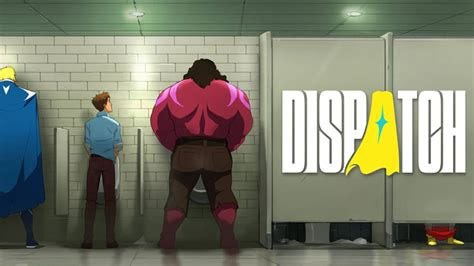
I’m a fan so far. That’s understating it out of an abundance of caution. I’m impressed, I’ll admit it, but a couple things give me pause (including my own inability to let myself just like things, I wonder what that’s about). Not only am I having fun, choosing interesting dialogue, and truly moved by some character moments, but also I found myself taking in the animation style, body models, and even character dynamics that in any other game would be unimportant, just for flavor, or set-dressing.
The Good
Characters/World
Dispatch takes place in a world in which superpowers are relatively commonplace: you can’t assume people have them when you pass them in public, but powers are common enough that folks with those powers are able to sustain their own economies, communities, and social circles.
I love the way the game has constructed and introduces the player to these superpower-influenced industries and spaces. Robert, the player-character, takes on the persona of Mecha Man, a title held by his father and his grandfather.1 He has no powers himself but has gained access to their environments, and he does so anonymously (at the start).2
There are bars that cater only to the powered and not to normies.3 Cops and firefighters work alongside (or against) the powered as part of their standard duties. Entire corporations have emerged to support, take advantage of, or employ the powered.
Within these superpower communities, individual characters have already begun to stand out, even in only a few hours of gameplay. Blonde Blazer (superhero, big thighs, voiced by Erin Yvette, you get the idea) isn’t just an obvious romantic choice, nor does she fit into a reductive girlboss role. She saves Robert (sometime subversive, now fairly common; nothing innately special here) and offers him a job as a dispatch operator for the Superhero Dispatch Network (SDN)—a corporation that sells subscriptions which entitle the subscribed to call for superhero assistance. Over the two episodes, Blazer has said and done a few things I wouldn’t expect. She drinks straight ethanol (or Super Beer, which is awesome) and contains a fascinating mixture of direct and noncommittal conversation styles (she knows what she wants to ask and says everything she needs in the lead-up, but she keeps talking around it, seemingly to give herself more time; is it possible to procrastinate while doing it?).
The other eventual romance option is Invisigal, formerly Invisibitch, which is admittedly much better (dark hair, contrarian, voiced by Laura Bailey, you get the idea). Like Blonde Blazer, Invisigal shines from under the trope pretty quickly. We see some real introspection, places where she errs and where she’s right, and emotion other than anger within an hour of meeting her. Her power is cool, too: where BB flies and is strong, Invisigal can turn invisible only while holding her breath.
For a game that’s trying to please Telltale lovers and also move forward with their medium at the same time, I’ll take these slow relationships as a real win. It’s been great to talk to everyone so far and learn their deals. A surprisingly fascinating conversation comes at the end of Episode 2, with Phenomaman (the front-facing hero for SDN). He reminds me a little of Captain Hammer from Dr. Horrible’s Sing-Along Blog, and for now that’s a good thing. More to come, for sure.
The other characters are interesting so far, but I just haven’t been with them enough to tell much. Robert’s team available to him for dispatching are called the Z-Team, and some of them are already nice standouts. Sonar and Prism are my current favorites.
Hacking and Dispatching
The game exists in, basically, four separate mechanics: dialogue options, quick time events (which are optional—you select whether you want them the first time you boot the game), dispatching your team of reforming supervillains to respond to subscriber calls, and hacking into different softwares.
The hacking is fairly simple so far, but it does benefit from some true engagement and I assume will continue to become more complex as we go along. Robert is able to hack into other systems. The player guides a ball through short challenges. Fun enough.
Dialogue options are as Telltale has had them for nearly 15 years and where adventure games in general have adopted them for a decade now. Industry-standard, reliable, and welcome. And now with smoother and sleeker graphics!
I’m playing with the QTEs, and so far they’ve had a nice balance of ease and challenge. I missed a couple in the first major fight (which Robert/Mecha Man always loses). Another Telltale staple that I am glad to play.
The dispatching is…odd for me right now, and I think that’s good; it shouldn’t feel familiar. I’ve only played the tutorial as HR training and one day at the workplace. It seems on the surface like a mobile management game: respond to a call, choose which hero to send, and wait to see whether they’re successful. Success depends only a little on chance; it mostly hinges on the hero’s skills, which is really nice. The best way to play the dispatch minigame (can I call it a minigame if it’s the conceit of the videogame?) is to know your Z-Team.
I was impressed! The playing is far more complex than any mobile game I’ve known with a similar conceit, and the heroes’ banter was wonderful. The player gets to start knowing them, feeling out their strengths and weaknesses, and even gets to help them on a couple missions. I’m satisfied with how it feels for now and am very excited to get back.
Robert
Robert Robertson (yes, that’s his real name) is really cool so far. Voiced by Aaron Paul, I can get a good sense for his humor (sardonic with a touch of hope), his personal values, and his motivations. After that loss in the beginning of the game, he needs a purpose, a reason for waking up, a paycheck, and ultimately an opportunity to do what he was already doing as Mecha Man: helping people.
It’s classically noble. All good.
So Robert (and we) ask: What do we do after we accept defeat? How do we move on? Community and purpose seem to be the answers.
But what’s unstated yet clear to me is how much Robert needs a dream job. No, he doesn’t dream of labor, but it also doesn’t seem that he ever had a day job before. At least not one he cared about or excelled at like he did working as Mecha Man. SDN might be what he needs most.
The Bad
(kinda)
(these are really just because we’re so early in the game and some simplistic ideas haven’t had time to get complex yet)
A corporation that requires the labor of superheroes
And that brings me to the fact that SDN is a private corporation. I assume that some criticism of it as a private venture will come up in the future, but so far characters in the game have only offered positive views of it (the game itself has included some HR-language satire, inviting us to make fun of the business; it’s a workplace comedy after all). BB is very excited about the company; Robert takes the job because they’ll let him help people, which has yet to be more complex than the “stop that crime” and “put out that fire” type of calls. Looking forward to more pointed and direct satire or even criticism of the company as we go forward.
Protect capital
A lot (not all; see below) of the heroic actions we’ve seen so far maintain the status quo and protect property and capital rights. That’s not evil, obviously, but the game seems to suggest that “doing good” is synonymous with “following and enforcing the law,” which isn’t necessarily true. It’s a problem with superhero stuff more generally, of course, and I do expect this to get more complicated at the game goes on.
Robert uses violence both on his own terms to stop crime as he sees it and for the corporation to protect the interests of those who can afford to pay them. Shouldn’t superheros be working to expand housing access, go after the companies that don’t let their workers unionize, and feed as many as they can? I’m not just saying this stuff as a raging leftist communist democrat woke hivemind queer blue hair having ass bitch with pronouns. In fact, this is a relatively minor issue for me right now. The game shows a few examples of helping people without any law or crime attached.
I just want “help” to mean “improve the situation and material conditions of the poor and the weary” and not only “stop crimes.”
Thankfully, the dispatching part of the game has a ton of places to actually help, whether or not there’s a crime or legal issue. The heroes Robert sends out can assist someone crossing a street, save a kitten, and put out a fire. Great stuff. So this isn’t actually that great of a sticking point for me, and like I said I expect it to be complicated as more episodes are released.
The same or something new?
This is less an issue and more something I’ll be looking for going forward. Is AdHoc recreating the Telltale formula for old fans to say they’re back? Or are they trying to tell us that they want to do something new in the genre?
The increased game mechanics beyond dialogue and narrative choices is certainly a change, though not unexpected or unwelcome. We might remember the money-saving from Tales from the Borderlands as a way to simulate some Borderlands ideas into the Telltale model. Crafting worked in the same function for Minecraft Story Mode. Telltale was all about bringing some specific ideas from their IPs into their five-episode structure, though maintaining a distinct voice and remaining identifiable as adventure games (more emphasis on dialogue and story than on urgency or play-skill).
The trend continues, but the new dispatch element in, well, Dispatch, adds yet another valence. For now, it’s odd, but I’m liking it. The characters are still the heart of the game.
End
And that brings me to my conclusion on Episodes 1 and 2: I really enjoy them, and I’m very much looking forward to more. We’ve got an excellent Telltalian foundation from which the game can continue to expand and explore. Laura Bailey and Erin Yvette both said that Episode 4 was what to look out for, so I will.
Permanent judgments are on hold. I want to see how everything develops and how my decisions shape more interactions and possibilities going forward.
Oh! I forgot! Ashley Johnson caught me off guard playing a reporter in the scene when Mecha Man officially announces that his suit is broken and he cannot continue his work (you know, from the fight we lose). That was nice. In the same scene, MM says that the suit can’t be repaired, and almost immediately a different reporter yells out, “Can you repair the suit?” Incredible.
And even earlier, when Robert isn’t in his suit, to begin a fight, the player is offered the choice between [STOMP] and [PUNT]. I chose [PUNT] (duh), and the mech suit barged through the wall and kicked the enemy clear through the building and out the opposite wall. Choosing that with no context for what the punt would actually entail was very fun.
I’m going to stop now before I list out every little thing I liked. It’s neat, and I’m hoping for even better. Be at peace.
He might not have powers, but he has a mech suit. Bulkier Iron Man situation.
Now that I think about it, it’s weird how quickly Dispatch reveals Robert’s identity to other characters; in superhero media, I’d expect that to come later and be a massive issue. It’s more or less tossed aside in the first episode in just a few lines (Robert is initially surprised but is fine with it, especially because his alter-ego is still publicly a secret from what I can tell).
I’m gonna call all people with superpowers “the powered” in this one. Might change it in the future. Not a term from the game. Just trying to combine “superhero” and “supervillain,” which are both used in the game.
I've been eyeing this game for some time now. It looks good, but I was on the fence. This was a great write up! I'm looking forward to more of your thoughts, it's making me more intrigued!