
Dispatch Thoughts: Episodes 3 and 4 [for real this time]
Things are actually heating up

Hey folks. I’m Dr. Evan Moore, and I overthink the games I play.
On Wednesday, 29 Oct, episodes 3 and 4 of AdHoc Studio’s Dispatch were released. I played them Wednesday and Thursday. I’m very impressed.
I’m reviewing Dispatch as it releases to celebrate this newest installment from former Telltale developers. If you missed the first one, you can find it here:

Let’s get into it.
We got romance, baby
One of the more exciting aspects of this game in its run-up to release was the introduction of romance options. Telltale has long been famous for its story-driven games with a large capacity for player input.1 In Dispatch, most of that input comes in romance and other relationships.
The two candidates are Blonde Blazer, a classic hero with flight and something akin to a plasma beam shooting out of her palm, and Invisigal (Visi, formerly knows as Invisibitch), a reforming villain with more than enough goth aesthetic and punk attitude. Sadly, though we live in a post-Karlach world, Malevola the demon with a massive sword is not an option. You can see my previous post for my full thoughts about that:

While Visi and Blazer seem like the same classic binary depiction of women as love interests we’ve seen plenty enough times already, I’ll give the writers credit: these characters are very fleshed out for only 1-2 hours of screen-time each. I won’t analyze them too much here for fear of spoilers, but I’m pretty happy with the level we know them at this point. I’ll put it this way: Visi is not subtle, and I like it; Blazer is quite subtle, and I like it. No wrong answers, my friends.2
It’s telling that the player-character is a white man and the two love interests are women. Not exactly ground-breaking stuff, demographically speaking, but that doesn’t take away from my engagement or enjoyment. It may for others.
Banter
The dialogue takes a massive step up in these newest episodes, and I thought it was already in a good place at the start. The jokes hit and reflect their characters very well. There aren’t even that many “jokes.” Like most high-quality sitcoms, Dispatch relies far more on banter and character-based interactions than on typical jokes.
This sometimes comes in the characters speaking past each other or winding up in a weird situation. Often, it’s ridiculous dialogue that could believably happen but is still shocking to think about. For example, Visi in ep 4 asks Robert whether he’s ever masturbated inside his Mecha Man suit. Insane question. One of the options in response is, “Yes,” and Robert’s actual voice line goes even further (of course that’s the line I picked). Royd (my main man) calls the whole conversation an HR violation.
But at other times, humor comes from the characters ripping each other apart. I wanted to list a few examples here, but I want to make sure you can find them on your own. Ask for my favorites in the comments or in messages if you want to know! Several moments in these episodes made me guffaw and/or pause the game.
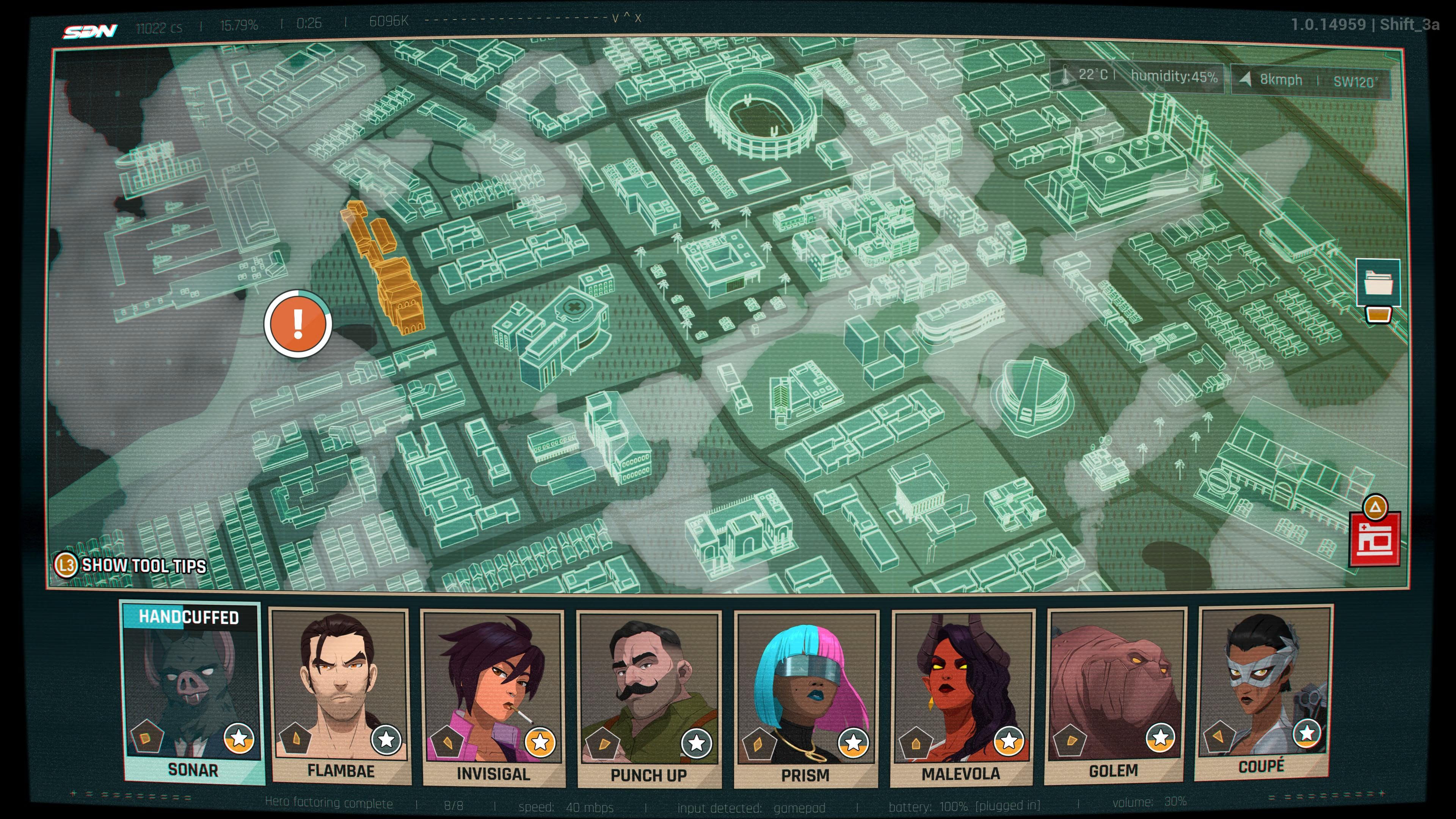
The Dispatching part of the game
It’s not easy; it’s fun; it’s well-crafted for each narrative moment. The screenshot above is from early in episode 3. This is the game: Robert chooses which of his eight Z-Team (aka Project Phoenix) members to send on a mission. The player needs to strategize here; there have been a few times when my best team member for a certain mission was already busy on a different one, so I had to accept either missing that mission entirely or going with a sub-optimal group.
By the end of episode 4, I was in the 30th percentile of dispatchers. There’s a learning curve, and I missed some pretty obvious points.
However, I’m improving at this part of the game, and the game goes easy on you. Missing a few and failing at a few others still allows Robert and the team to increase their skill points, and the narrative still moves forward.
Really, I’m impressed at how each shift at the dispatch desk has felt unique. There are new stresses, new situations, and new issues for the team to overcome—both in and out of the dispatching itself. It also helps to show some of the more satirical parts of the game so far. To quote one of them during a mission, “If we unionize, will Blazer kick our ass?” I like that they’ve already unionized in one way: they share a single ass.
Workplace satire, or workplace hope
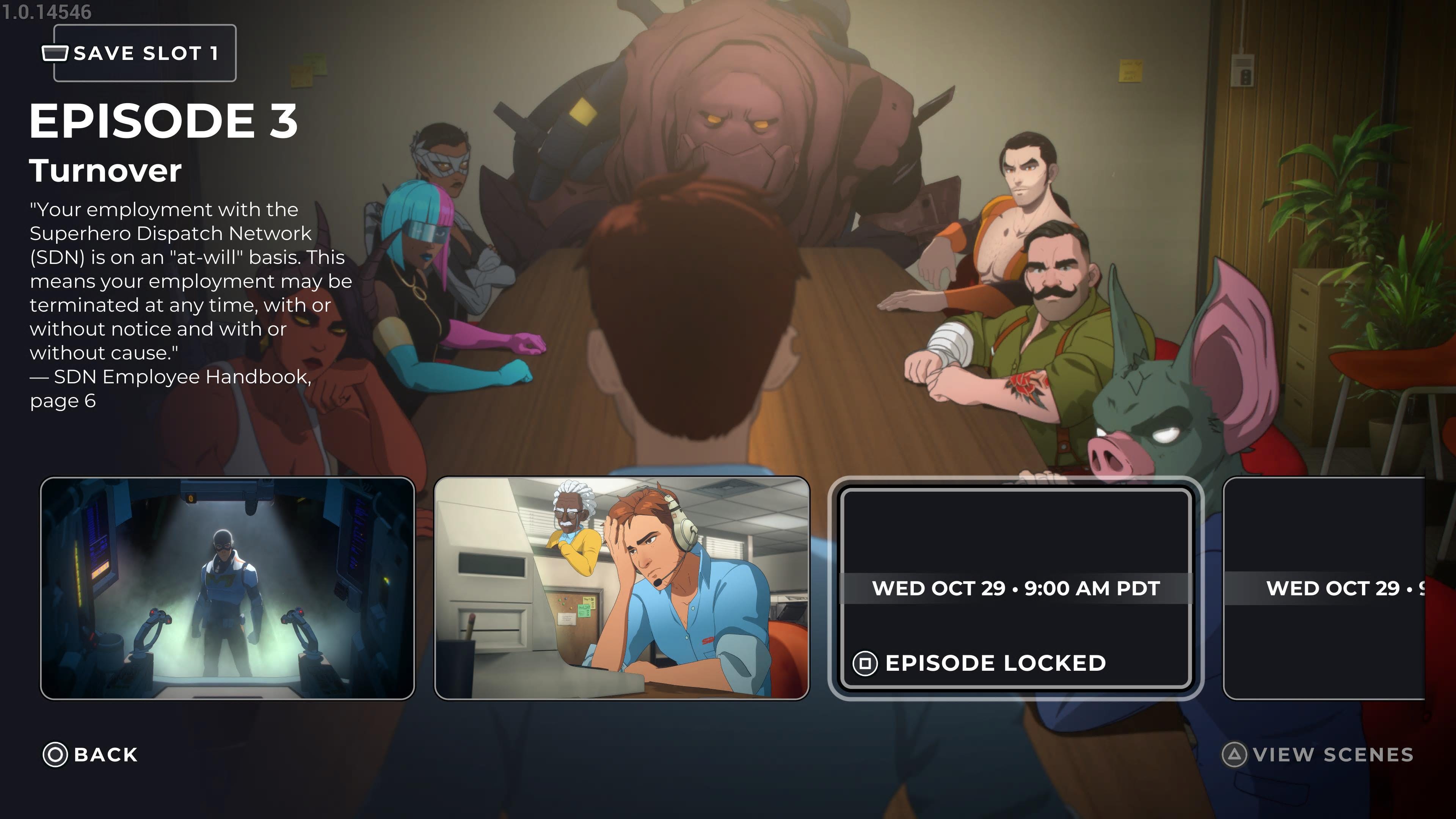
Each episode’s title is a business-speak term, and the description is a quote from the Employee Handbook that relates to the crucial moment of the episode. In 3, Robert has to let someone go. The game is poking at the justification for the firing and even the situation as a whole. That is, there is no clear reason why someone has to be fired. The company is not losing money, and none of the team members are actively taking productivity away when on their missions to help subscribers.
Blazer (Robert’s boss) says that it will show the Z-Team who’s in charge and that they need to take their jobs seriously. She also vaguely hints at a quota, that the company should increase turnover by cutting the worst-performing hero. There may have been more here that I missed, but it seems shaky at best. We’re cutting someone because we can and in order to instill fear in the other members of the team. For some extra drama, it seems that Visi (she works for Robert) is the lowest-performing on the team.
The game doesn’t press this point. It’s a choice Robert doesn’t want to make, but he accepts that he has to. He doesn’t push back. He instead assumes that responsibility and stands by his choice. I can admire that, though I’m left wondering whether the references to the handbook, the obviously negative corporate culture, and the presentation of work are not supposed to be satirical at all.
Robert gives a Jeff Winger speech to his team.3 I think work is more hopeful in this game. It’s a purpose, a goal, maybe even a reason to wake up. Their work is both gaining a community together and helping others, literally, by answering the calls. Reforming villains is noble, and it seems to be working, though not easily.
A final remark on Phenomaman
Let me end with Phenomaman, the Superman-like figure. He is not part of the Z-Team, but rather the front-man for the company (at least, in the beginning).
Without getting too much into it, I have to admit that the way he’s presented in episodes 3 and 4 doesn’t work for me. I know we’re making fun of Superman and that this is a more accurate version of what that character would be: uncaring, unconcerned with others, observant but unwilling to act, unable to truly connect or understand any other perspective. And it works. It’s funny, too, I guess.
But I hate characters that cause harm and have no knowledge, recognition, or sympathy for that harm. I don’t care that he’s sad. Someone teach him basic etiquette. Or at least sue him for the damages he’s causing???? Can we get some reparations please? No? It’s just to show how sad he is and how oblivious he is to human suffering?
But I get what he’s representing, and I’m all for that.
That’s all for now! Episodes 5 and 6 come out next week. This is long enough. Be at peace.
There have been debates on the nature and effectiveness of player choice in Telltale narratives. Many argue that the choices are often superficial, don’t matter in the end, or else converge on the same ultimate narrative twists regardless. I have tended to claim that decisions in games always matter, even if they have no plot- or character-concerned consequences. Getting to choose in the moment is still a choice. For Telltale, converging stories are not only practical and understandable from a developer point of view, but also they tell us that our player-character is not the only one in that game-world with agency. While I would like some ability to choose my direction in a changeable narrative game, I try to take the game as it is. I would be happy to expand my thoughts on games of this style in more detail in future essays. For now, I accept that we will change this story and that we will all have different experiences. I’ve twice now done or chosen something that the game tells me only 1% of players did.
As of Thursday afternoon, about 2/3 of players had so far gone with Visi. I expect that number to level off as people replay and as the player-base expands. We’ll see whether that choice is locked in for the rest of the game or if there’s more uncertainty to encounter. I get the feeling, with still half the game unreleased, that we’ve got plenty of stress ahead of us.
Jeff, from the show Community, is famous for his speeches in which he can take any idea and turn it into a metaphor for his current situation. I invoke him here because Robert makes up this speech in the moment (we the player do, at least) and it lands. The team actually does get inspired, and they have a much better shift afterwards.