
How Should Choices Be Balanced with Good Storytelling Tools?
Jon Ingold has talked about choices in games for years, and I think he's got the right angle

I love when games make decisions for me and force me to live with the consequences.1 More, I love when games allow me some decisions and deny me others. Looking at which moments are malleable and which are in stone provides useful and meaningful thematic analysis every time.
Jon Ingold, narrative director at Inkle (Heaven’s Vault, Overboard!, the new TR-49) and author of interactive fiction, ends the Choices Matter Festival broadcast (still running here) with several well-explained takes on the nature of choices in gaming. He’s got a few central principles, and I want to offer my own thoughts.
In short, and some of you may remember my discussing this previously: a choice matters at the moment of choice, not at the moment of possible plot-relevant consequence. Choices matter because we allow them to matter, even if the game does not have a response in the code or if the plot converges. But the effect of those choices on a player’s enjoyment is based on the strength of the writing, the character, the situation, and therefore the level to which the player understands the character at that time.
Jon’s Axioms
First, let me point out his most repeated view of well-designed choice: that moments of choice should align the character and the player, and only when aligned will the choices be taken seriously.
Jon gives the example of a hypothetical The Lord of the Rings game in which the player, as Frodo, would be able to reach Mount Doom, toss in the Ring, and head out with all ten fingers. For Jon, such a choice would ruin one of the central themes of the text. Frodo needs to fail at the end in order for this to still be The Lord of the Rings.2 So, the choice should not be up to the player on whether he completes the quest. Jon floated the possibility that we could have a choice to harm Sam in two different ways, which accord with Frodo’s place at that moment in the story and would frustrate players in a healthy good-storytelling way.
The trick to making sure that frustrating choices like this are narratively interesting and making sure they bring out the best storytelling (not all options lead to good stories, not all stories make for interesting games)3 is, according to Jon, alignment. What I think this boils down to, based on his remarks and the LOTR example, is that the player should understand why the character is here and what options that character feasibly has. At the best moments, the players and character should intuitively think of the same options. This means that, sometimes, there is no good option.
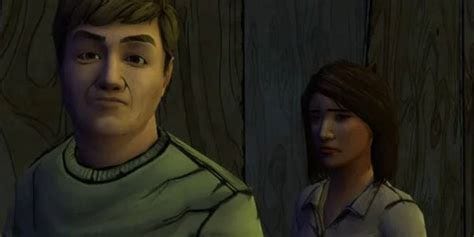
And the use of such a “no good option” choice in a game is sometimes incredibly effective. I can think about several moments throughout Telltale’s ludography, especially in The Walking Dead; having to pick the less bad of two not-great options was one of the main selling points of those games. We might think of Doug-v-Carley in Episode One, where it is very clear from the situation (a zombie attack) that whichever character you don’t choose to help might (does) die. The final major decision in the game, Lee’s amputating his bitten arm before the infection spreads, leaves the player wondering whether any hope still exists in this world. The despair grows when we realize that amputation didn’t stop the infection. I find it a beautiful moment of powerlessness; other players felt betrayed by the game’s premise. But no matter what, Lee does not leave season one alive.4
But there are some excellent non-consequential uses of “only good option” choices in games that Jon highlights as well, which I’ll consider the second axiom. Games can use non-consequential choices for character, roleplay, emotional, or otherwise immersive information and motivations. Jon’s example for this is Horizon Zero Dawn (2017), which is one of my favorites. Periodically through the game (and its sequel), the player is given three options for how Aloy can respond to a provocation: a heart for empathetic, a brain for cunning, and a fist for aggressive. As a 6-year-old, a kid throws a rock at Aloy (bullying never dies). She catches it, and the player chooses what she does next: a heart for dropping it, a brain for throwing it and hitting another rock in the kid’s hand, and a fist for throwing it and hitting the kid in the face.
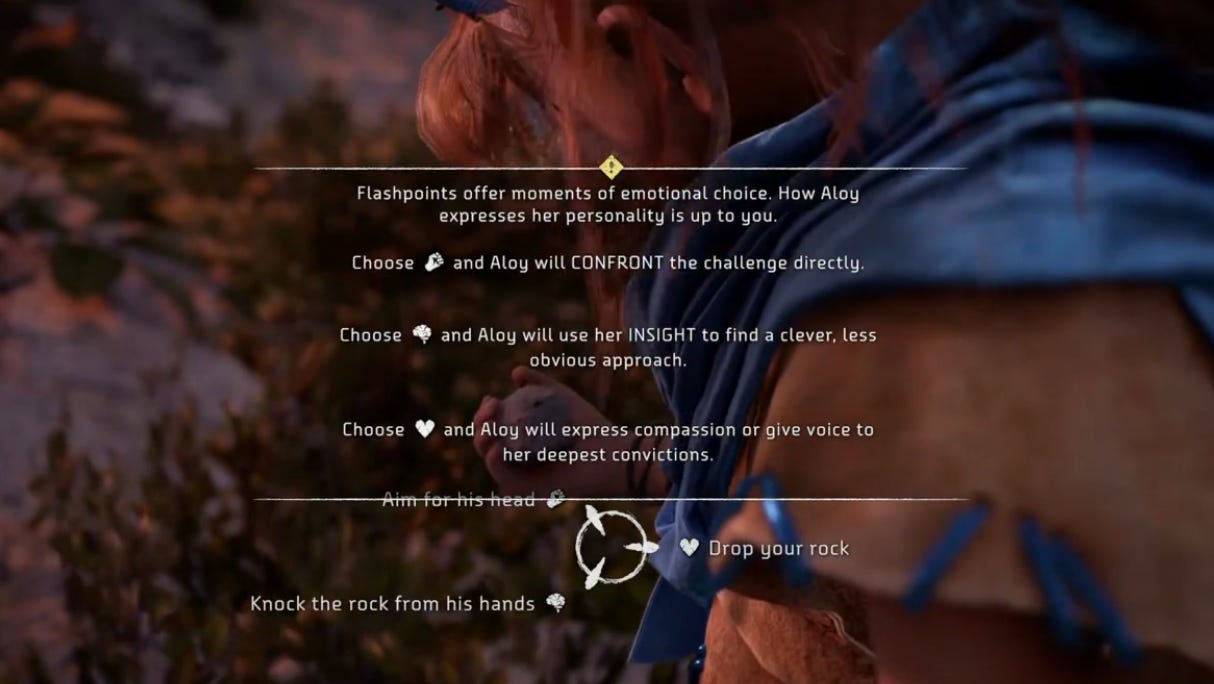
This choice in particular has a small consequence a couple hours of gameplay later, during the Proving, but only in the dialogue that grown Aloy and the rock-thrower (I forget his name, he sucks) say to each other. I remember a Q&A with some of the game’s writers a few years ago in which they said that all three options, every time they come up, are “canon” for what Aloy “did” in those moments. That’s an outlook I personally enjoy and can academically defend.5 All of those dialogue options exist on top of each other and are equally likely, and the lack of significant consequences allows the world some uncertainty and the players some real buy-in to their version of Aloy.
I especially enjoy the cunning/insightful option, and I almost always pick it (except for the one playthrough I did with a vengeful Aloy). It’s a nice break from the dichotomy that’s been done plenty of times over the last 20 years, like Mass Effect’s Paragon-Renegade.
End
I’m gonna leave things here for now. I have some expectations for The Wolf Among Us 2 and several more thoughts about demos, but I’ll keep those for later.
On a personal note, we just got a new kitten named Cassiopeia (she’s currently on my lap trying to eat the buttons on my shirt—while I edit, it’s Scott the fluffy orange guy on my lap), and I’m in the middle of preparing for the new school year. A shorter post, I know, won’t hurt anyone’s feelings.
And hey, look at the new logo for Play Moore!
It’s very cool.6 My friend Matthew made it; check him out on Instagram at MattCDROM.
The first game studies course I ever taught, over two years ago, was titled “When Games Have Agency.” We looked at games that take agency away from players at key moments or railroad/linear games that still effectively make the player feel guilty for the actions of the protagonists. The Last of Us Part II is my quintessential example. Spec Ops: The Line and the interactive fiction work Infidel are scholarly darlings with this idea. All of these are met with the same criticism that they heavy-handedly force a player to feel bad for a decision that they were forced to make in order to play the game. This is relatively short-sighted; the games don’t think that you, the player, are in some kind of moral destitution. The point is to feel the guilt and shame of the main character, and to point out the ethical issues that we take for granted during gameplay.
Adaptations always come with baggage, usually in the form of a cost-benefit analysis. Is a change worth the cost it incurs? In this case, I’d agree with Jon that Frodo has to fail; Peter Jackson agreed as well. Adaptation is a secondary field of study of mine; I should probably talk about it more. Jon is within the general scholarly consensus here that adaptations should be seen as new takes on original material, rather than attempts to supplant the original text. Adaptations cannot ruin the texts they’re based on; the originals still exist unharmed. What we can hope for from them are interesting interpretations and changes that might reflect cultural values, themes the adapter wants to hammer home, and fan-fiction discourse. Essentially, adaptations should increase the level of our conversations from “I hate that they took out Tom Bombadil” to “Aragorn receiving Anduril during the muster of the Rohirrim shows that Jackson & co really did see him as an uncertain and unwilling king, but Tolkien’s having Aragorn claim Anduril before the Fellowship leaves in the first place shows that book-Aragorn was ready for the responsibility.” Doing so makes the adaptation more interesting and enjoyable, but more importantly we become more attentive and careful enjoyers ourselves.
This principle I have seen in scholarship, advice for young interactive fiction and choice-based game writers, and interviews with developers for games that famously did not include options many players thought they should have. Telltale is chief among such studios; Dontnod (Life Is Strange) is up there as well; we might also consider Quantic Dream (Heavy Rain, Detroit: Become Human) and AdHoc (Dispatch: you can read my reviews for that game on the reviews tab of my Substack website).
It’s Choices Matter Fest! If you haven’t bought the The Walking Dead “definitive series” yet, do so.
The idea of an immutable “canon” of events within fictional worlds has ruined modern media and discourse. I blame Athanasius of Alexandria.
cf. Bradicus: “My name’s Bradicus. My nun-chuck has a knife on it, and also a gun. And I’m very cool.”
The choice-and-consequence criticism, I think, really comes from a clash between what the player expects and what the game in question is actually trying to do. If someone's coming to one of these 'choices matter even if they don't pan out' things from a capital-G Gaming background, they're going to come to it with the understanding they'd bring to, say, an RPG of similar budget and design, and, properly, by the way, identify the lack of consequences for various actions as a disappointing oversight or lack of agency. Someone coming to them from Visual Novels or just out of a hunger for the property or a story they've heard was good, will not even notice the lack of agency, and, properly, by the way, identify the narrative being told well. I think where it causes problems is when games that prioritize narrative coherence over agency are marketed, sold, or critiqued as equivalents to games that do the inverse. I've definitely been rubbed the wrong way when a game basically gives me a personality test and then ignores the result anyway. And I get the philosophical notion that the act of choosing affects the story and your reception of it even if nothing happens as a direct result, but I can't help but imagine at least a little more effort going into making them feel valuable every time I run into it.