
Simulacrum: It's Everywhere
A little bit more on the word that explains everything around us

I have seen The Odyssey twice. I enjoyed both times. I have issues, but more good than bad to say. The theaters literally applauded when Antinous died, so I’ll take that win. I am not going to engage deeply with online conversations about the movie, though I have taught the epic in a few classes.
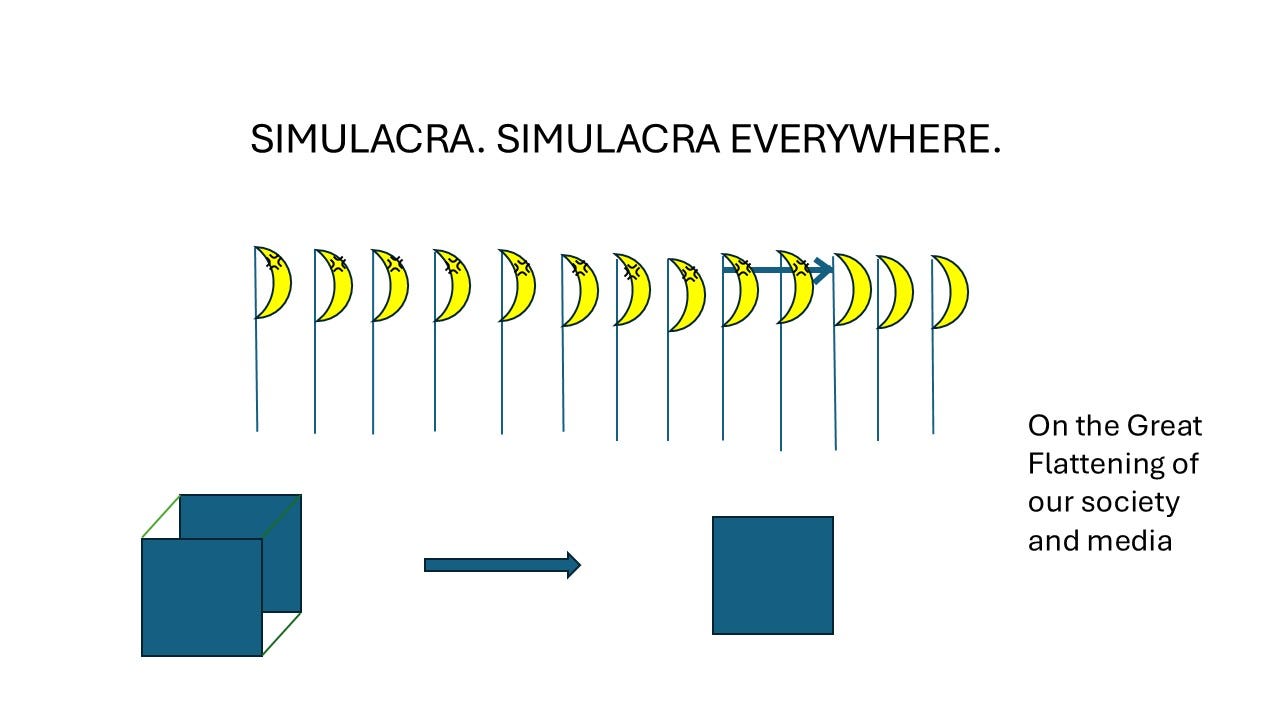
I’m not going to engage deeply because, at this point, we’re talking about the fact that we’re talking about talking about it. Adaptations of incredibly famous works adapt the original, of course. But more importantly, they adapt our ideas about the original. When Nolan went into this project, he knew he’d be competing against and responding to Madeline Miller, O Brother Where Art Thou?, what we know about the late Bronze Age, and broad cultural references just as much as, if not more than, he’s adapting Homer himself.
Nolan also is making a film for 21st century westerners. He’s responding to our own ethics and mores at least as much as he’s coming from Homer.1
The cyclops Polyphemus is more monstrous and less ‘civilized’ in Nolan than in Homer. Same goes for the giants. Circe breaks xenia out of justified fear, though we may believe her methods too extreme and her victims undeserving.2 Odysseus doesn’t kill all 108 suitors; every modern audience would find that a bridge too far, so Nolan may think. Or Nolan himself at least would consider it too far. The clearest example of Nolan having to contend with 3000 years of fan-fiction and re-interpretation is probably his inclusion of Sinon, who does not appear in Homer but is identified as the person who tricked Priam into accepting the horse-gift by Virgil and others.3
And this brings me to simulacrum. Nolan’s The Odyssey is one. It has references to references, some completely absent from the original. Most of our conversations about the film also participate in some simulacra: we talk about concepts divorced from the starting point.
End of hook.
Growing up, it all seemed so one-sided
Opinions all provided
The future pre-decided
Detached and subdivided
In the mass production zone
Nowhere is the dreamer
Or the misfit so alone
Rush, “Subdivisions”
The term
Neither “social construct” nor “meme” fully capture the uncanny feeling you get when something is taken as absolute, factual reality but in truth is just a reference to a reference, not anchored into anything that matters.4
To this we give the name “simulacrum” - something with only the appearance and veneer of reality, but is merely held up and enforced by some reference to itself. This is when something still controls our lives but is 5 layers deep in metaphor and allowance. An agreement we make with others around us for modern society to function, with the consequence that we can imagine no reality outside of the agreement.
So when we say that Polyphemus is a monstrous beast, we’re going off of our ideas of cyclopes more than we are the actual discussions between Odysseus and Polyphemus in the story. Fantasy and myth are the most at risk of becoming references unto themselves.
When Tolkien wrote about Orcs, he knew none of his readers would know what they are. It was his job to present them as soldiers of the evil armies, but not without complications: they have languages, societies, desires, etc. By all means, they are a people held captive by Sauron’s power and malice.5 Today, when we see an Orc in a fantasy setting, we already know what Orcs are, and the creators of this story/game/setting know that we know. Their goal is no longer that we might take their version of Orcs completely originally or independently, but instead as part of a larger media ecosystem. Modern Dwarves are based on Gimli; The Lord of the Rings shows a much more diverse set of dispositions than Gimli son of Gloin alone.
All tropes and genre conventions work this way now. They have had an originator or a source of their popularity, but now they are ubiquitous and expected. Terry Pratchett once claimed, by analogy with Mt. Fuji in Japanese prints, that every fantasy author has three choices with regard to Tolkienian references: either you incorporate them, you ignore them entirely (which is its own statement), or you stand upon them.
And yet, at least for me, the best fantasy cannot only be based on Tolkien and later fantasy writers. They need their own source material from which they draw. For Tolkien, it’s medieval mythologies, what he called fairy-stories, some Biblical motifs, and romances.6 For Martin, it’s medieval histories, especially those about the War of the Roses and the Anarchy (the civil wars in England before the English Civil War). For R. F. Kuang, it’s Chinese myth and early 20th century Chinese history. For Jemisin and Okorafor, it’s several West African traditions and afro-futurism. All of these authors also put plenty of themselves and their desires into their works so that they aren’t just recreations of older material.
But a lot of assumptions we bring to media come from popular imagination and reduced ideas, rather than anything that actually comes from the source material or reality. Adapters of history must ask themselves which concepts must be true to the era and which concepts can be fudged toward modernity so that the audience gets the right idea/feeling/vibe.
To bring it back to the epigraph above: when we artificially separate ourselves from where we began, we are in danger of losing what made the thing special in the first place. We become determined and one-sided. Commercialization and spectacle operate as simulacra. The idea of the Super Bowl has immense cultural power, even when most people don’t want football. The nostalgic idea of the 1980s allows us to sanitize and romanticize the mall as a location, even though we were complaining about suburbia, conformity, and consumerism even back then (as in “Subdivisions”).
Watch out for when you bring references to a new work of art, and wonder whether this work deserves those references to be read into it. More importantly, watch out for when forces (usually not good ones) want you to care about the idea of something existing, even when the original reason for that thing no longer matters or exists.7
A few game examples
First for me is alchemy. Alchemy games are based on player expectations that alchemy = potioncraft, which is not really what alchemy was 600 years ago. The vast majority of alchemy games ignore the metalworking and chemical compounds that made up the lives of Albertus Magnus and Michael Scot.
And that’s okay, probably. We have a new understanding of what I call “ludic alchemy” in these games, based on the search for the elixir and on what alchemy looked like in other games and media. Alchemy in games primarily refers to how alchemy has been used already.
Experience points and leveling up are simulacra as well. Originally invented as a quantitative way to show improvement over time via practice (which is how real improvement works), XP has only gotten more and more abstract over time, with some odd exceptions. D&D first used the amount of gold you plunder to track your XP—a stat completely divorced to whether your character actually got better at any certain task, but at least requires you to have done something first.
XP becomes so abstracted from the character’s improvement that God of War (2005) has the player collect Blood Orbs in order to improve weapons and abilities. Demon’s Souls (2009) uses Souls for upgrades and currency. This is blood sacrifice on its face, human sacrifice made unto the demented gods of digital worlds. As a buddy of mine likes to point out, because XP is so abstract and is based on violence as a matter of expectation, Star Wars Knights of the Old Republic II: The Sith Lords (2004) questions whether it’s at all ethically defensible to kill and therefore improve. Undertale (2015) is similar.
But, in general, it goes unquestioned. The RPG-est Assassin’s Creeds (Origins [2017], Odyssey [2018], and Valhalla [2020]) reward players with XP for completing quests, discovering locations, killing enemies, killing enemies in fun ways, completing optional challenges, etc. Abstract in such a way that it plays on our expectations of XP more than on what it means to improve at something. Simulacrum.
Plenty of games retain the practice-makes-perfect concept, though. Skyrim (2011) levels up individual skills based on successful (and sometimes unsuccessful) actions, not rewards for combat. No human sacrifice here (well, not for XP at least).
History-inspired games deal with simulacra a ton. I won’t go through all of them. Let’s take Skyrim again, for the sake of keeping small the number of examples. And because I’ve been talking about Skyrim’s alchemy in my scholarly writing a lot, so it’s on my mind.
Legends of the Norse are a major influence, of course. So is the way in which premodern people conceptualized magic. Some of these have direct references or equivalents in Skyrim, such as Hrothgar (a character in Beowulf) being the name of a great keep atop the tallest mountain. That’s cool. The hero goes through trials and tests like characters in Norse myths do. The Dragonborn battles a dragon at the end with friends, also like Beowulf.
But most of Skyrim is based on references of references. Magic especially has no relationship to anything that’s actually been practiced on Earth. Check out this video from Religion for Breakfast:
Fantasy magic has its own rules and logics, based on themselves. This is most true with quantitative systems, which games tend to require unless the magic is not gameplay-determined.8
Skyrim is also based on our ideas of the Norse more than the Norse themselves. But more than that, it’s based on other pop culture media inspired by the Norse. Whiterun has aesthetic, mythic, and environmental similarities to Tolkien’s Edoras (the capital of Rohan and home of Theoden). The mead-hall Jorrvaskar is its own place in Whiterun and should be taken on its own terms, but it’s also clearly inspired by Heorot (from Beowulf) and Meduseld (from Tolkien). Jorrvaskar diverges in that it is not the grand hall of the town’s leadership.
End
I’m going to end this discussion here, rather than ramble on with more examples from more games. So you all tell me: what’s a time when you realized that something you were looking at was based on other references and pop culture imitations, rather than an original or trying to be original itself?
Does this bother you? Do you enjoy when we can separate our media from a supposed starting place? What games only exist in reference to themselves while trying to be grander? Which games have obvious real references and therefore feel realer?
Would love any comments, emails, etc with any thoughts you might have, including on any future topics or things you’d like to read from me. My last two posts (on God of War Laufey and on Sony discontinuing physical discs) are two of my most-viewed and most-liked. Do you all want more industry criticism? News analysis? Updates on my teaching? The things I’m researching, reading about, and writing? I write best when I know it’s something people will enjoy seeing from me.
My next piece will be on alchemy in Chants of Sennaar (I’ve teased this one already), and after that I plan to return to some older series and get a few friends in here for a collaborative article on anti-fascist games. Stay tuned!
My favorite filmmaker right now is probably Eggers, and it’s because it doesn’t really feel like he’s making movies for modern people.
I think Nolan wants us to believe Eurylochus (Od’s first mate) when he says they wouldn’t hurt her. Same with when Od says that this men just want to get home. But do we actually believe them? Up to you.
The Odyssey does not include a “neutral” telling (from a narrator directly) of the Trojan Horse and Fall of Troy. As in the film, we hear about the horse and Odysseus’s role in its conception from Menelaus. Nolan working the end of the war into flashbacks is one of the strongest features of the adaptation.
There are things that are made up (i.e., “social constructs,” things that we more or less agree to accept but could be something other than what they are) that still have their basis in lived experiences, and so are not simulacra. Gender, race, how we spell words, idioms, and politics are all constructs but still real. Money and singing about chestnuts at Christmas, less so.
This does not automatically mean they deserve our sympathy. More and varied discussions about Orcs in Tolkien specifically are always fun. They are not automatons, nor are they born from goo as in the Jackson films.
Medieval “romances” were not primarily interested in romantic relationships. It’s the term we use for stories written in vernacular languages with a focused protagonist and journey. It’s the predecessor to the “novel” as we see them.
For the Americans in the room, let me point to the Electoral College or the semi-permanence of us having 50 states. For the Christians, think about how conservative evangelicals taught about the Bible, as an idol with inherent meaning rather than a book written by a bunch of men over 1000 years trying to understand their relationship with the divine.
This is not to say that fantasy magic should only contain itself to what Bronze Age Hittites thought magic was. This is to say that we need to admit to ourselves when something is just a convention, based on other conventions. That way, when we do encounter something from the ancient world, we don’t put our modern ideas onto them and force them to say what we want.
What a fascinating topic. Thinking about it makes me *feel* like I know some examples but I can't really bring any examples to mind right now. But your point about XP immediately made me think of Undertale as well. The game deliberately leads you to think that XP is what you need to get stronger -- and you do get stronger but XP and LV are not what you think they are. You just think like that because of preconceived notions. So would you say that it challenges that notion, in a sense?
The use of Souls as XP [and indeed, as a universal currency] is, I think, more than arbitrary renaming, at least in that first game. The whole plot of Demons Souls, after all, revolves almost entirely around the discovery of Soul Arts, the manipulation and use of souls, the theft of souls, and the accumulation of souls, which is the domain of the profane and otherworldly. The arc of the game's progress, the ONLY way for you reach the final heart of evil, is to be invited, having gorged yourself on souls, possess 'power beyond human imagination,' and become yourself the greatest Demon within the lands. That the later games just reuse and then arbitrarily rename the mechanic weakens the narrative impact if Demons wasn't your first game, but it's a pretty powerful twist on XP, especially when you consider what happens to souls that are 'lost' or consumed to fuel the Demons' insatiable hunger.