
Dispatch Thoughts: Episodes 5 and 6
In which bringing work home is more powerful than a room full of superheroes

Hey, what’s good, I’m Evan, let’s talk Dispatch.
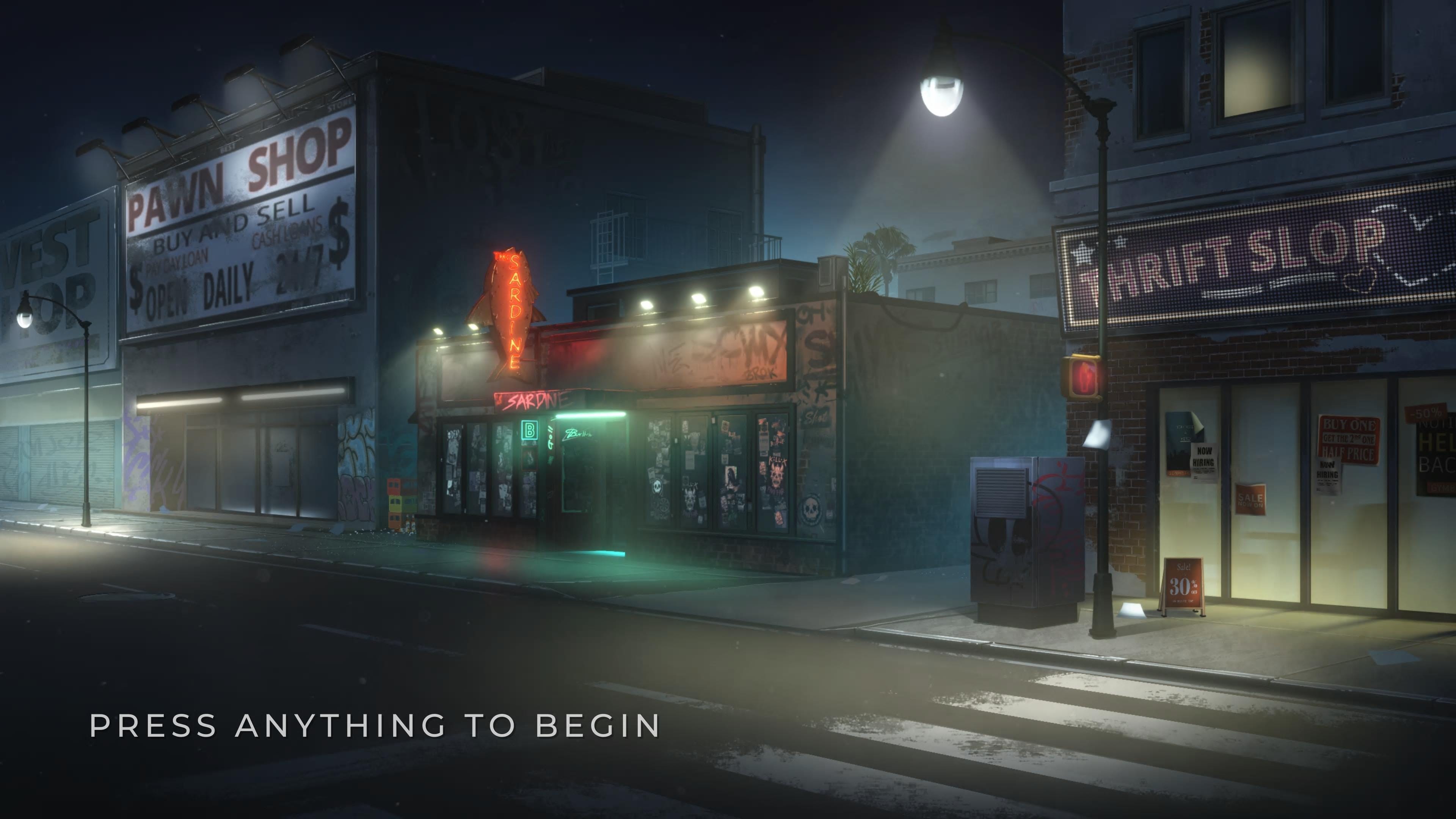
These are the two best episodes so far. We’ve got our found family, our actions have consequences (both in the game and in my own perception of the game), and the dispatching game continues to capture my attention. I have a few notes, but they say as much about me as they do about the game. This is the best I could hope for.
The puppy is great. Characters are working. There’s some interesting thematic information and an openness for us to explore our own ideas as we reveal the plot. That is, there are many avenues for interpretation here; the game doesn’t over-analyze itself for us (at least, not often), and I think that’s a hallmark for solid art.
Make sure you check out my previous Dispatch Thoughts, and I’ll get into these new episodes.

![Dispatch Thoughts: Episodes 3 and 4 [for real this time]](https://substackcdn.com/image/fetch/$s_!2Aqs!,w_140,h_140,c_fill,f_webp,q_auto:good,fl_progressive:steep,g_auto/https%3A%2F%2Fsubstack-post-media.s3.amazonaws.com%2Fpublic%2Fimages%2Fb5d1df26-37c8-4fa1-8d2d-d8ef1f5ecda9_3840x2160.jpeg)
Dispatching
What even is genre?
AdHoc Studio is formed by former Telltale devs. You’re probably sick of hearing that by now. We should expect this to be an adventure game, as a kind of Return of the King, since the last Telltale-associated game was The Expanse (2021), and Telltale was already defunct and nearly out of the adventure sub-zeitgeist by then.
But Dispatch is not an adventure game. In this section, I’m going to explain what I mean by adventure, introduce “modes” as a missing dimension in online gaming conversations, and show that the mode makes for sense for viewing what the dispatching is really doing.
The quick-time events and dialogue options from adventure standards of the 2010s are still here (indeed, they exist far beyond the companies that first popularized them). But the dispatching game and the ability for different players to do differently based on their skill at that game creates enough urgency and requires enough dedicated focus to disqualify this game from my categorization of a true adventure (which tend to have the player force the story forward through puzzle-solving, sometimes with only some minor time requirements). Strategy-adventure might fit better, similar to the action-adventure genre we created to allow for player-controlled action (usually violence). Maybe even a more generic story-driven? But I don’t think that’s a genre in the first place.
Genre is hard, dude. I mean, what is it? Why do we use them? Why did we borrow this word, genre, from books and film in order to express mechanical differences in the experience of playing games? Should we go by what the developer uses to describe/sell their game, or by user tags on Steam? Should we stop thinking in terms of genre altogether and just use adjectives?
I have many more questions than that, and I will try to deal with them in fuller and longer and better ways in the future. For now, I want to talk briefly about the primary mode of Dispatch, or the way it inspires us to act and engage as we play.1 You may know all about modes, but give me a minute.
Mode is often more important than genre, and some categories that I think are modes are so common and useful in popular fan discourse that they are often called genres. The distinction between mode and genre is not helped by Steam’s community tags not being able to make the distinction on their own. It’s not the fault of the community; both are integral and deserve to be listed in tags.
The best example of this is probably soulslikes, which usually fits within the larger multi-genre designation “action-adventure RPG” (AARPG). But note that it does not always fit into AARPGs, and that’s a problem for genres. Soulslike mechanics can be implemented in card games, in puzzles, in action, in survival, in horror, etc. Since it can mean the same thing in Hollow Knight as it does in Elden Ring (for just one aspect of this mode: difficult bosses that require patience, cunning, exploration, greater player skill, and several attempts), it’s better to think of “soulslike” as a mode rather than a genre. It tells us about our experience as a player and how we should think about our engagement with the game, not the type of game we’re discovering as we access more and more of the software.
It’s a useful designation, but it needs additional information to communicate a meaningful idea for what playing the game is like and what the game is.
Dispatching in service of a whole
The primary mode of Dispatch could be listed “story-driven” or “narrative game” or similar. This is a super common mode in adventures, so it tracks, and it’s exactly what we expected out of this title. The dispatching game is incredibly fun, but it only works in service of the narrative surrounding it and the character interactions.
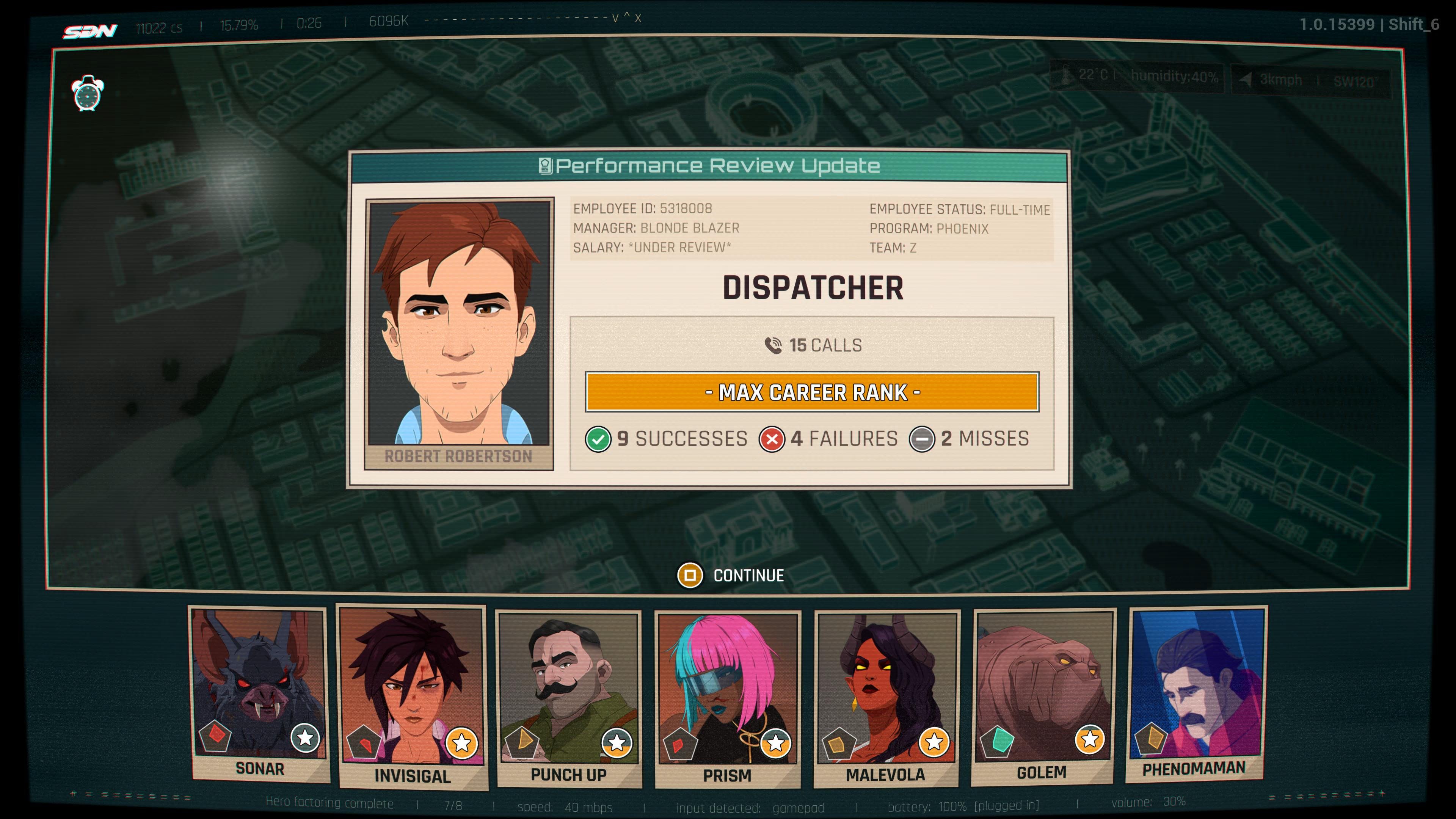
I’m not good at dispatching, at least not as good as I wish I were. This screenshot is after a particularly difficult shift (it’s supposed to be difficult; there are narrative reasons). I played episode 5 within a day of its release, and up to then 90% of players had done better than I did at dispatching.2
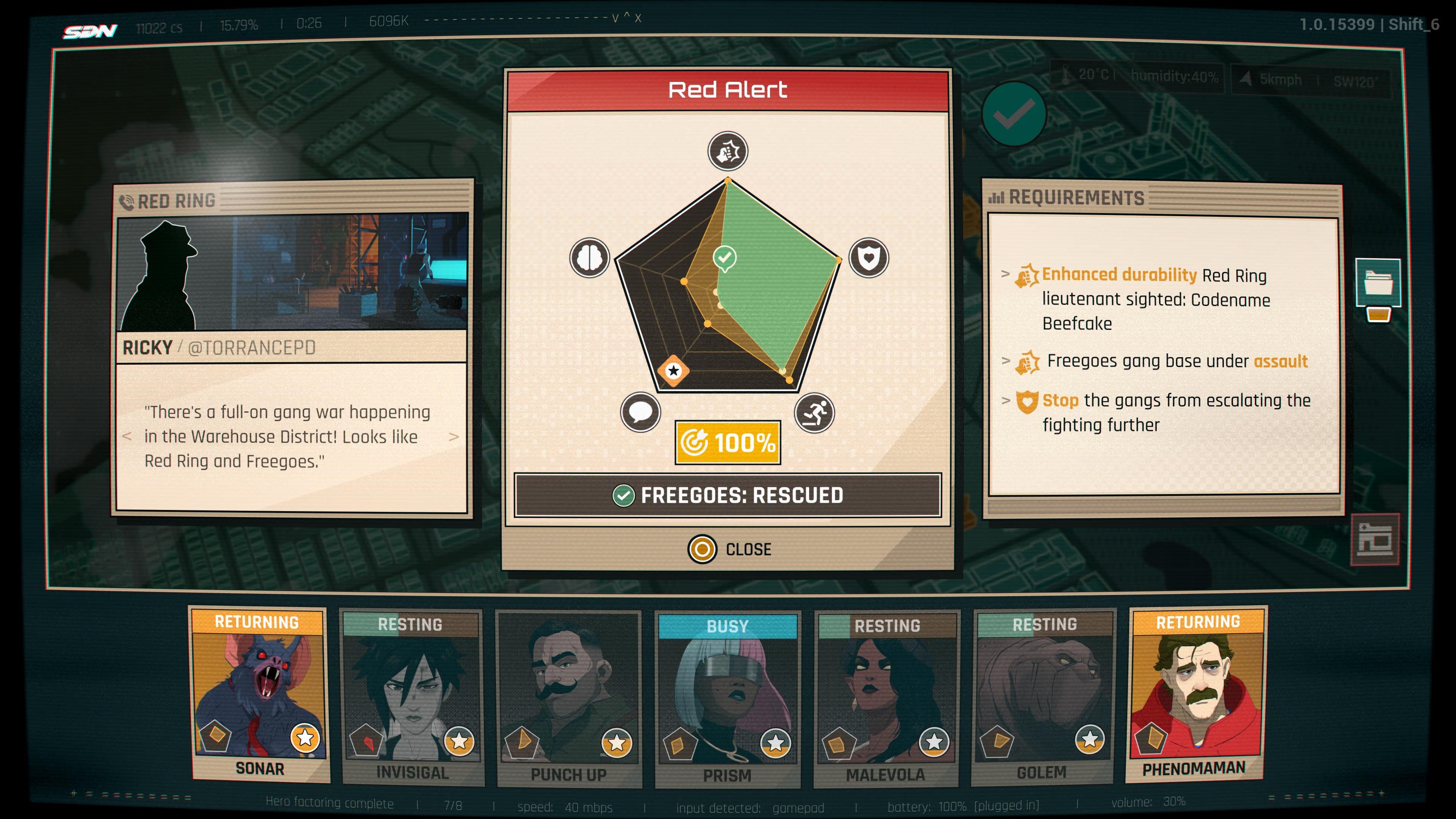
But the game is inherently forgiving, and the narrative gets full priority: even just doing okay at dispatching still levels up the Z-Team and Robert. And that leveling feels earned. They are getting better, whether the player does or not. We certainly will—it is practice, after all3—but that’s not as important as the community being formed.
Here’s why this matters.
The game, so far, as mastered a balance between accessible and narrative-driven gameplay (the narrative has not been harmed by my mediocre work) and providing a challenge for us players to overcome (I still want to do well).
Dispatch, I think, is hoping that we feel a real connection to the characters. I don’t just want to improve Robert’s life (he really needs help, man). I also don’t want to let my team down. I brush off a failed mission if I knew it wouldn’t go well, but failing a 71% success chance in episode 6 was a bummer.
For the sake of time, I’m going to end this here. The dispatching serves the narrative, rather than the other way around, and I consider this an absolute win.
Characters and themes are better pronounced
Everything has developed really well. I’m happy with where we are and deeply excited for what comes next. Episode 6 begins with Robert suffering yet another injury:
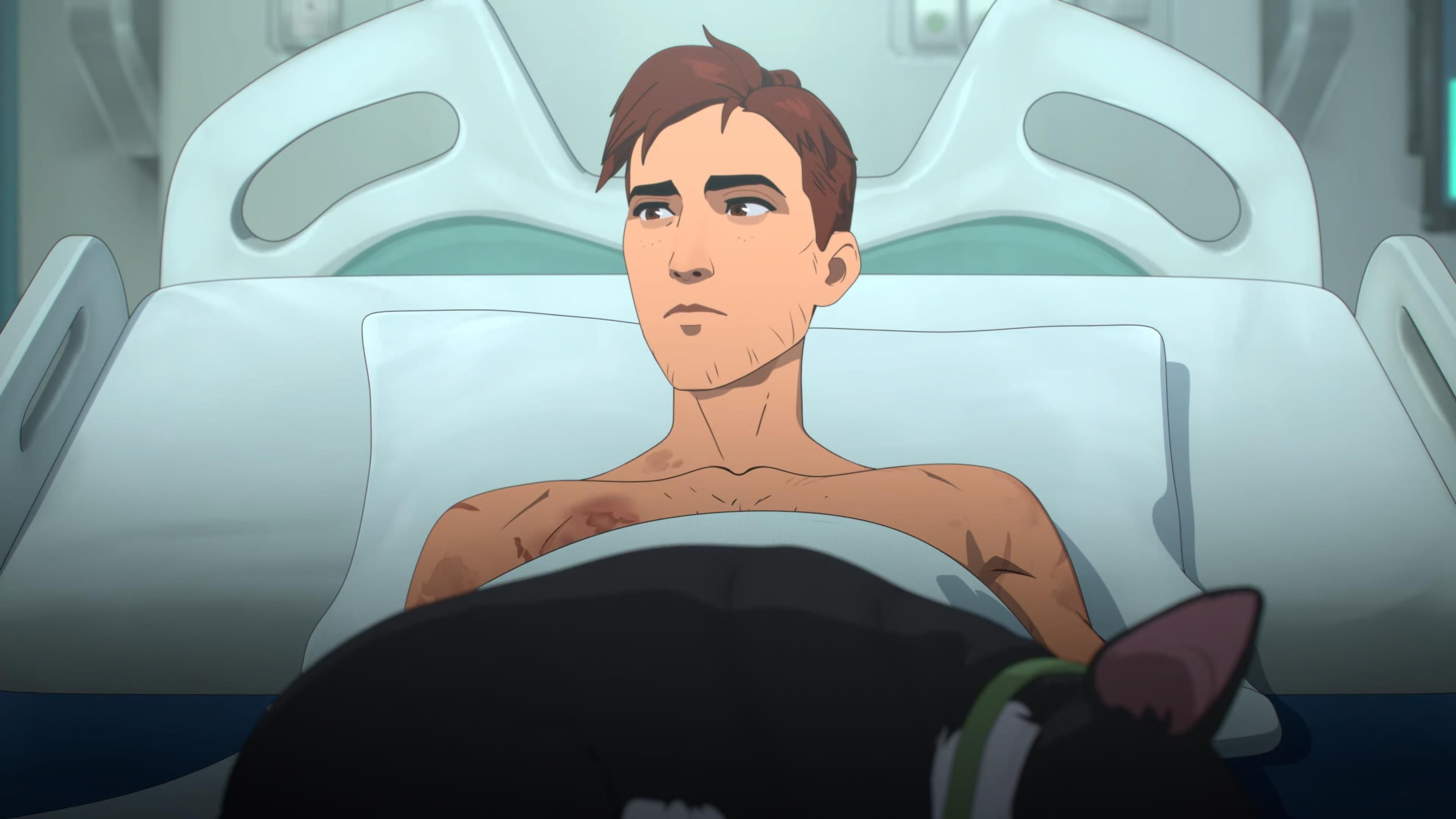
Episode 6 ends with some tragedy—fully expected for the penultimate release, still got me. Several questions remain, and many fates hang in the balance.
The greatest joy has been the Z-Team’s acceptance of Robert and their additional trust in each other. Most of this happens in banter during the dispatching itself, but plenty comes through the dialogue-choice-driven scenes that surround dispatch shifts. The romance plot has progressed (slightly) over the most recent couple of episodes—not to the extent I thought it would, though.
In my playthrough, I have sent Malevola on the most missions, and I’ve paired up Visi and Golem so frequently that they have unique dialogue and skills to reflect their growing teamwork. The game literally has a “synergy” system, to use its word.4
This brings me back to the discussion I’ve hinted at previously about how this game treats labor and the workplace. Working for SDN is all-encompassing. Their shifts go late into the evening (makes sense for the type of work they do), and nothing of note takes place outside of work or the relationships created at work.
Is this a normal pattern for a story like this? Yeah, basically. Does AdHoc want to trample on workers’ rights? No. Am I applying my own cares and feelings onto a text that did not ask for it? Yes. Does it matter? Not really. But is it there? Absolutely. This game pushes the workplace as a center of action and identity far more than normal.
Robert is injured at work, is visited in the hospital by coworkers, and leaves as soon as he’s awake to go back to work. SDN is not a job. It’s a lifestyle, maybe even a cult. Paratext that surrounds the game continues to participate in a little bit of workplace satire, but continually nothing in the game itself is really aimed at or geared towards a critique of SDN as a corporation. As with my take last week, Dispatch is trying to set up a world in which work is purposeful and meaningful to the worker.
And, you know what? If work is life and coworkers are family, then let’s make the most of it. Let’s go out drinking together and accept Robert as one of the team (ep 5). Let’s bring his work computer home with him, throw a party to celebrate his return from the hospital, and plan a major breakthrough in the subtle long-plot (ep 6).
The long-plot
And that brings me to the long-plot and the real meat of Dispatch. Slowly and carefully, the game has layered in overarching details of underground organized crime and continued threats from Shroud, the “bad guy” from the prologue.
It’s been really nice to see repeat offenders while dispatching; I’ve started to get a sense of dread when I hear Vanderstenk’s name. Separately, a new organization has been causing mayhem over and over again. Keeping a—what’s the ear-equivalent to the phrase “a watchful eye”? A listening ear?—Keeping a listening ear open for clues about this group has proven fruitful through the newest episodes.
And in episode six, things come together. And I really enjoyed how it did. Debates flared among the SDNers, with Robert trying to counsel. It was foreshadowed well and written well at the big moments so far. I’m enjoying it, and I’m looking forward to some heavy heartbreak and grief going forward (at least, I have to assume).
A small issue
The romance plot was not as heavy as I would have liked in these episodes, especially since the fourth one ended with a choice of who to go on a casual date with.
I saw the love interest only a few times, but only one dialogue choice carried an important decision. Robert hasn’t spent any more time with them outside of work or a large group gathering. Dialogue has made it clear that the romance is still happening, of course, but the game has been focused on other issues. Good enough for me, but a little odd.
And, I mean, can I just add again that everyone is so hot? All these characters work in one dimension or another. Except for Golem (no offense, buddy, you’re just a little big for me) and Flambae (all offense, may your dreams be filled with feeling like you’re drowning). So the romance more or less on pause while Robert gets in with the Z-Team leaves me wanting more sooner.
But that’s it! The end! Really liking it. Hype for the last episodes this week.
I will end by sharing another two bangers from Phenomaman this week:
I’m reasonably excited!
and:
I am glad that [going through the breakup with Blazer] has given me time to learn about myself, but unfortunately what I’ve learned is that I hate me.
Until next time. Peace.
In literature, the genre tells you the type of story you’re reading, and the mode tells you how the author communicates and asks you to engage with the story. Horror, mystery, sci-fi, and fantasy are all genres; satire, comedy, and pastoral are modes.
One of the tracking stats at the end of each episode is your percentile ranking for successful dispatch missions. After episode 6, I was back to the 80th percentile, so I got a lot better.
I should speak more to virtue ethics and gaming, but let me skip that for now.
Certain characters pair well with others, and if you can discover them organically it feels like you really understand them.